When Space and Time Twist Together 🌀⏳ w Sean M. Carrol #scienceshorts
2 min read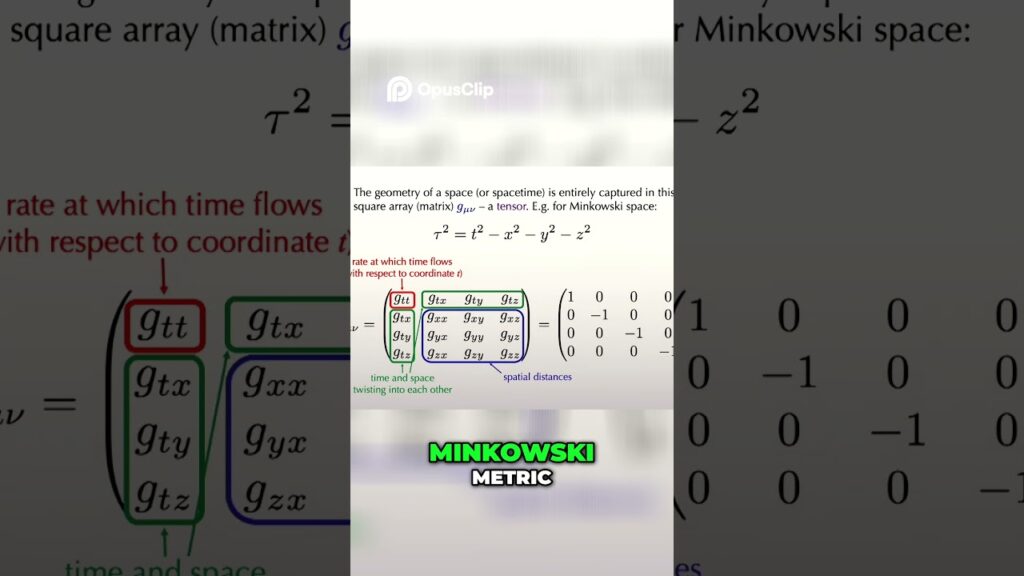
🌀 Can space and time twist into each other?
It sounds like science fiction—or maybe a scene from Interstellar. But in real physics, especially in Einstein’s General Relativity, this idea is very real.
In this video, we dive into space-time mixing—how space and time are not fixed, separate entities but part of a unified fabric that can warp and twist under gravity.
🧮 But here’s the catch: in the Minkowski metric, the mathematical model for flat space-time, there’s no twisting. It’s perfectly rigid.
So, if you’re asking, “When do space and time mix?” the answer is: only when space-time is curved, like around black holes or massive stars.
🎬 The speaker cheekily adds:
“When will I ever see a major Hollywood blockbuster in which that happens?”
Well, you might—but don’t expect it to match the math. Hollywood tends to use bending time as a narrative device, while physics sees it as a consequence of gravity and energy density.
🌌 Einstein’s equations allow for frame-dragging, time dilation, and even gravitational lensing—all real effects that prove space and time can “twist.”
But in Minkowski space (flat, no gravity), that beautiful complexity is absent.
This short gives you a glimpse into the subtle but profound difference between flat and curved space-time—and why it matters for how we understand the cosmos.
Keywords: Minkowski metric explained, spacetime twist, general relativity vs special relativity, curved space-time, Einstein space-time theory, what is frame dragging, spacetime in movies, Hollywood vs physics, time dilation, gravity and spacetime, spacetime warping, physics explained short, space and time mix, twisting spacetime, black hole relativity, Brian Greene space-time
About Author